
This post is educational for the purpose of building self-awareness. It is not a tool or substitute for professional or medical advice and should not be used to diagnose clinical anxiety.
From high anxiety situations like public speaking and looming deadlines, to experiences of being the “new kid” or going on a first date, we have all experienced some form of anxiety at some point in our life time. It is a normal and common human response to stressful situations to feel some worry or concern; it means you are present to your circumstances and are impacted by what’s happening around you.
The word “anxiety” is thrown around very causally in everyday language. Often times it blurs the line between a normal emotional response and a more serious mental health condition. Understanding the difference between feeling anxious and having an anxiety disorder helps us to appropriately support our mental health without mislabeling our experiences.
Anxiety as a Situational Emotion
Anxiety is a natural, evolutionary human emotion. It acts as a kind of alert system that is designed to keep us safe, alert and focused on something important and/or urgent in front of us. Your brain perceives a temporary threat and activates your sympathetic nervous system. This triggering of the “fight or flight” response sends the necessary biochemicals—adrenaline and cortisol—giving you a burst of energy to help you face the challenge.
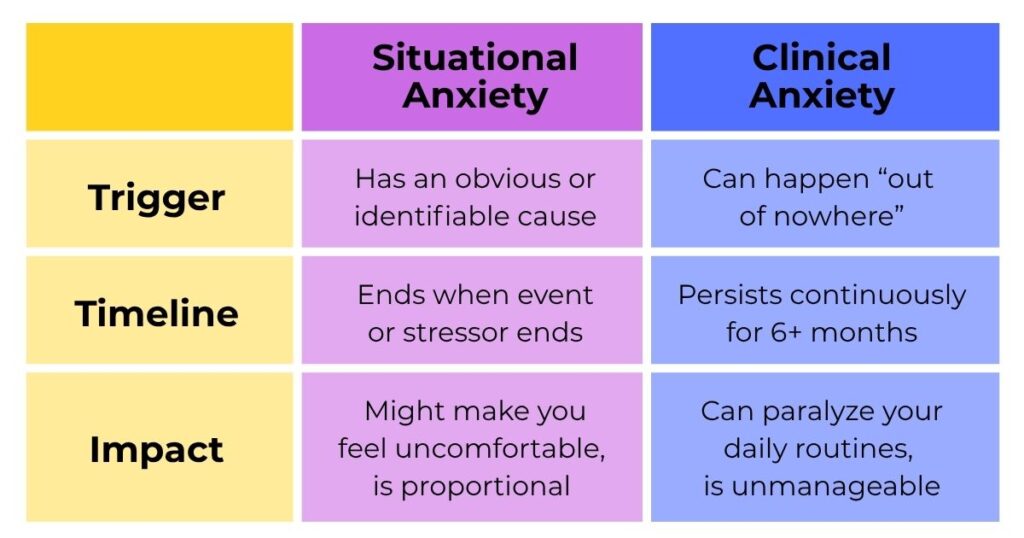
Anxiety in this way is tied to a specific event or stressor such as an upcoming exam or awaiting test results. It is usually temporary, dissipating once the stressor or event passes. The emotional response is also proportional to the severity of the circumstance, meaning your level of worry matches the scale of the situation.
Here are some examples of normal, healthy even, situational anixety:
- Feeling your heart race before an important job interview or big presentation.
- Ruminating thoughts and/or trouble sleeping for a few nights as you are waiting for results from medical testing.
- Experiencing “butterflies” in the stomach, mildly elevate blood pressure and clammy hands as you head to a first date with a new romantic interest.
The important thing to remember is that in situational anxiety this alert system turns off safely once the event is over and the experience can be managed with coping skills like mindfulness, deep breathing and time management.
Anxiety as a Mental Health Condition
Anxiety as a persistent mental health condition (like Generalized Anxiety Disorder, Panic Disorder, or Social Anxiety) is different and requires professional assessment and treatment. Three things to keep in mind in understanding the differences between situational anxiety and clinical anxiety are the 3 Ds: duration, distress, and dysfunction.
- Duration: lasts for more than 6 months and occurs on most days.
- Distress: causes significant emotional pain and feels unmanageable.
- Dysfunction: interferes with daily functioning and effects multiple areas of life including sleep, work, school, and relationships.
Importantly, clinical anxiety is “free-floating,” which means it is not connected to a specific or obvious trigger; The anxiety is seemingly caused by nothing in particular. It also out of proportion; it is as if the internal alarm is sounding at maximum volume for minor or nonexistent threats. This kind of anxiety requires assessment and care through mental health professionals.
Whether your anxiety is a temporary visitor triggered by a stressful week or a constant shadow you’ve lived with for months, your experience is entirely real and valid. Feeling anxious doesn’t mean you are broken—it means your body’s alarm system is working. Likewise, struggling with clinical anxiety doesn’t mean you are weak—it means your alarm system needs professional calibration and care. Recognizing which one you are experiencing isn’t about placing a label on yourself; it’s about choosing the right tools to build your path forward.
Identifying your anxiety as situational gives you the opportunity to practice your coping tools or begin to set boundaries. If you’re looking to create new skills, check out our tools for emotion regulation or five grounding techniques.
Or if you realize your internal alarm system hasn’t turned off in months, you don’t have to white-knuckle your way through it alone. Reaching out for support isn’t a sign of defeat; it is an active, empowering choice to take control of your health. Schedule a free consultation with one of our mental health clinicians.
Ampersand Counseling Collective works with individuals across Washington State who are navigating anxiety, relational challenges, and the particular difficulty of living in a divided world. We offer individual therapy on Bainbridge Island and in Issaquah, as well as online therapy throughout Washington.
Leave a Reply